
Why Microsoft Wins
What’s the Reason Behind Microsoft’s Success?

Microsoft is a weird company.
When you think of one of Microsoft’s long-time competitors, Apple, you’re forced to think about their genius marketing, beautiful designs, and wonderful products. Compare this to Microsoft, and it makes you realize that the company is the complete opposite of Apple.
Microsoft, indeed, is not very good at design, storytelling, marketing, or building great products. But what’s surprising to me is that when you look at the numbers, both companies pretty much overlap with each other: Apple is the second-largest company in the world, whereas Microsoft is the fourth by market cap.
How is this even possible?
Well, if you ever took the time to study Microsoft, you may know the reason. But if you don’t, let me share with you a Note I posted a few months ago that I think sums everything up well. Here you go:
Both juggernauts, Apple and Microsoft, are super successful. However, one more thing is clear though, Microsoft isn’t a beloved brand like Apple. If you walk down the street of any city in the world, you’ll at least find a few who’d say, “I just love Apple.” But this clearly isn’t the case for Microsoft.
Again, if you’re thinking, “Why is this such a thing?” I’d ask you not to be so hard. By the time you finish reading this post, you’ll have an answer.
But then, you may say, “Who cares if you’re a beloved brand or not?” Well, you’re right…as long as you’re printing money, you’re fine because the fact that you make money shows you have useful, valuable products.
Which absolutely is the case for Microsoft.
So in this post, what I want to do is explain why Microsoft wins despite not being very good at marketing, design, storytelling, or building great products. And the truth is, one shouldn’t take Microsoft for granted, as I find it interesting that the lesson Microsoft shares, other successful tech companies barely do.
So let’s understand Microsoft and why it wins!
What is Microsoft
The fascinating thing about Microsoft is that no singular power law product defines the company like Google’s Search, Apple’s iPhone, Amazon’s E-commerce, and Facebook’s Family of Apps. And while it doesn’t have a single power law product, Microsoft is one of the rare companies that rode almost all the technology waves.
Microsoft was a computer/software company from the 1970s to the early 1990s. Became a browser company from the mid-1990s to the early 2000s. Then rode the consumer tech wave from the 2000s to the late 2000s. Then became a cloud company from the mid-2010s to early 2020s. And now? It’s riding the AI wave from 2022 onwards.
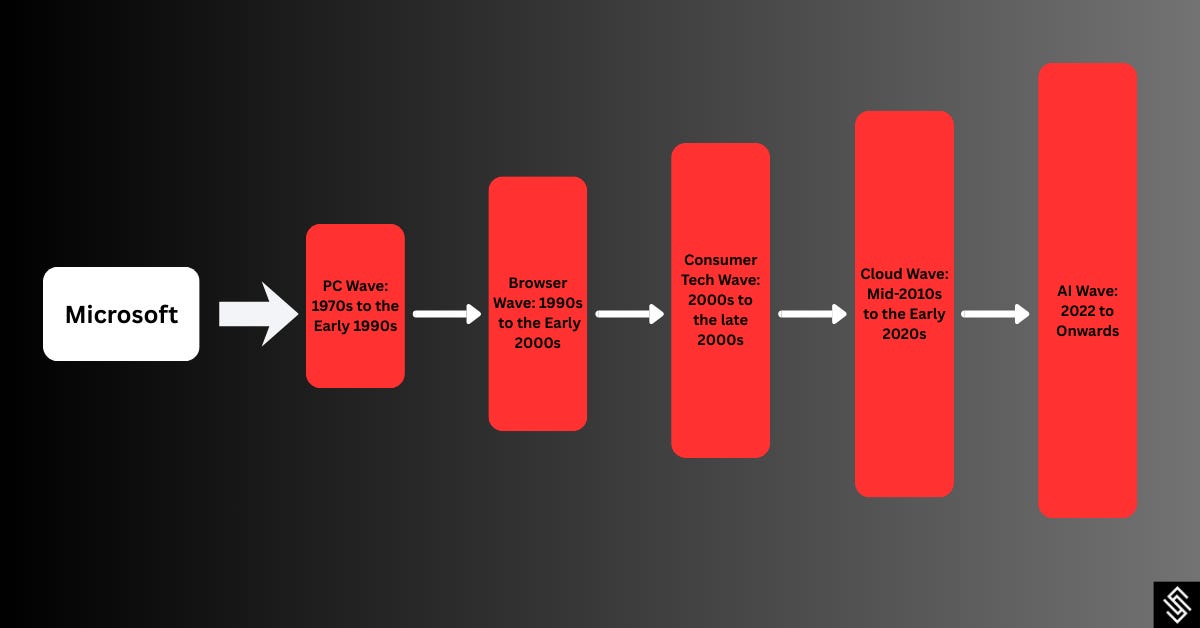
Not everything I wrote in the above paragraph may be accurate, but it at least gives a general idea of what the company actually was in that timeline. And so, it’s worth saying that Microsoft has never been as stable a brand as Apple in building lane-of-products.
Microsoft started with personal computers, which people initially thought were toys. But as years passed, the company built different domains of products from a web browser to smartphones to gaming consoles to developer platforms to cloud infrastructures.
Some products were mega hits, like Excel. Some of them failed, like Windows Phone.
When Microsoft was started in 1975, its mission was: “A computer on every desk and in every home.” And indeed, the company was so successful in accomplishing that mission. But now, 50 years into building, that mission has changed with a new one:
“To empower every person and every organization on the planet to achieve more.”
You can clearly see the direction Microsoft is moving into.
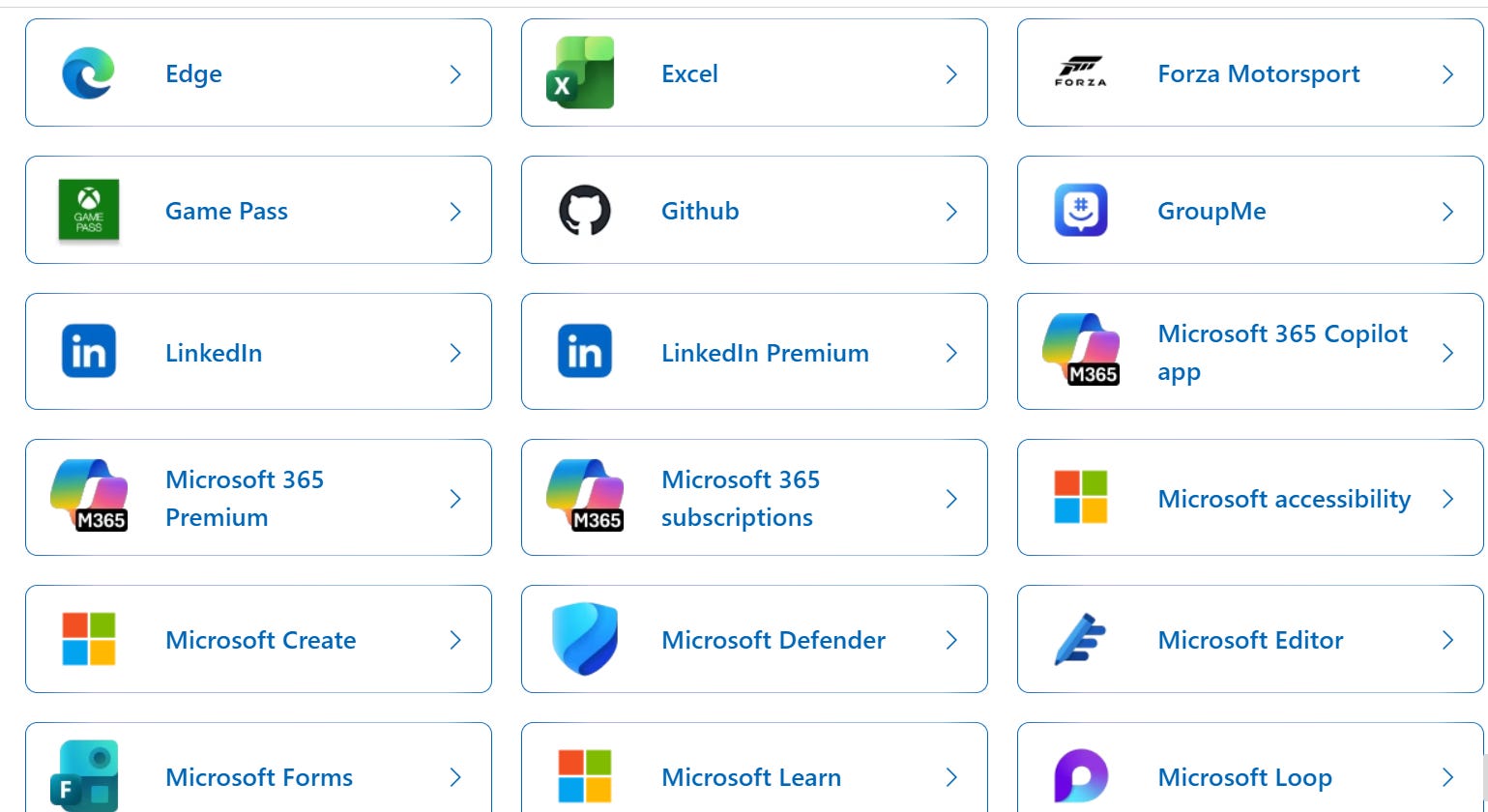
Microsoft is now the fourth-largest company in the world with a total market cap of $3.6 trillion, with the revenue reaching over $293 billion in 2025. And the company has more successful products than I can barely remember, including Excel, Microsoft Teams, VS Code, Windows, Microsoft 365, Azure, GitHub, LinkedIn, and Xbox.
So what is Microsoft?
Is it a software company? A gaming company? Cloud company? Computer company? Or an AI company? What the heck is Microsoft actually? Truth be told, as I said, Microsoft doesn’t have a single power law product like Apple and Google, making it hard to define the company with one of its successful products. However, in simple words, saying: Microsoft is a technology company that builds tech products in different domains wouldn’t be wrong, if that makes sense.
The Roller-coaster Ride
You may think that Microsoft has had a smooth ride, but the reality is, the company’s journey from the early 2000s to the late 2000s was not very good. However, Microsoft did fairly well prior to 2000—dominated the PC market, crushed Netscape, went public, etc.
It was only in 2000 when things went south, see the graph:
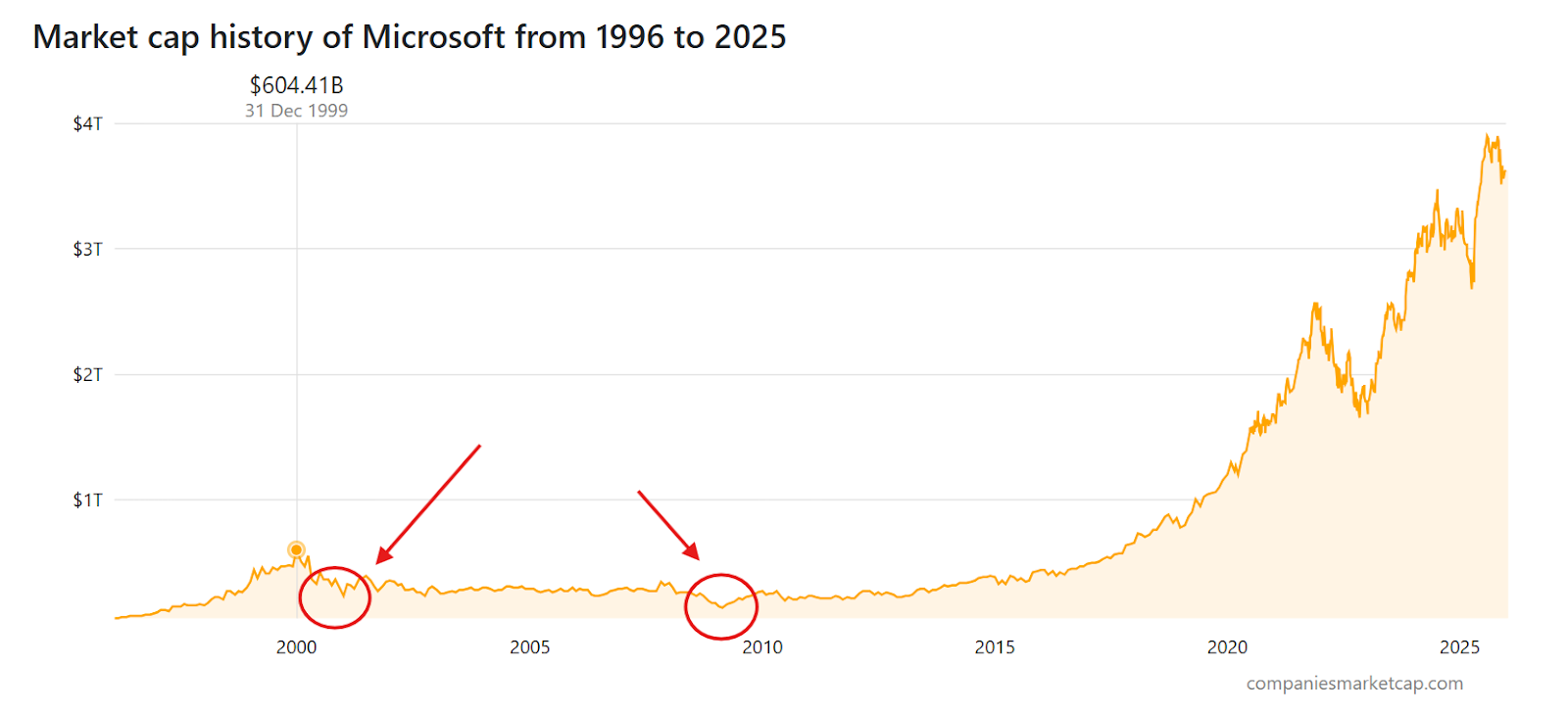
What happened as 2000 started? Well, a lot happened in that timeline. First, Microsoft’s founder Bill Gates stepped down as CEO, with Steve Ballmer taking over the position. Another important thing that happened was the Dotcom Bubble, later followed by the Great Recession—the two events that didn’t just crash Microsoft, but the majority of the tech companies.
Let’s touch on Steve Ballmer.
Under Steve Ballmer’s leadership, the company tried a bunch of new projects that it had never done before. For example, E-Reader, HailStorm (a web service), NTFS (data storage), Digital Music, and many others. But sadly, most of the projects didn’t really take off.
Not only that, under Ballmer’s leadership, the company focused too much on its competitors, responding with similar new products and features. And due to that, even though it was never an innovative company, it paralyzed Microsoft from making anything different or original.
Then began the Great Recession that collapsed the entire US economy, dragging tech companies like Microsoft to a near-death crisis, with its stock falling more than 44% in 2008. And because the company tried many different things in a bad economy with poor execution, it didn’t just fail on those projects, but also lost control over the products it was finding success in, for example Windows Phone.
The good news though? Microsoft remained a dominant player in the PC market even though the demand for personal computers was declining in the 2000s. However, if there’s one thing to say around this timeline about Microsoft, it’s this: From the early to late 2000s, the company became a big loser in the consumer market despite dominating the PC market.
The 2000s were a hell of a rollercoaster ride for Microsoft.
The Return of Microsoft
Microsoft started to take off again when Satya Nadella became the new CEO of the company in 2014. Nadella, before taking the CEO role, was the Head of the Cloud and Enterprise Group at Microsoft, joining the company in 1992. As he already had a good grasp of cloud computing, he doubled down on this very technology, which quickly paid off.
Microsoft Azure, which started as an experimental project in 2006, was founded in 2008, and officially released in 2010. The product was initially called Windows Azure as the technology was primarily focused on Windows PCs. But under Nadella’s leadership, the product was renamed to Microsoft Azure, focusing on broader use cases and global expansion.
However, what’s interesting is that before Azure found some success initially, the only dominant cloud provider was AWS, which was founded by Amazon in 2006. While Azure had only found product-market fit yet and started to grow, AWS was already doing over $10 billion in revenue per year.
Azure had to catch up, Microsoft knew. And frankly, it did—in 2019, within just five years under Nadella’s leadership, Azure surpassed $10 billion in annual revenue for the first time ever, and soon became one of the key revenue sources for the company.
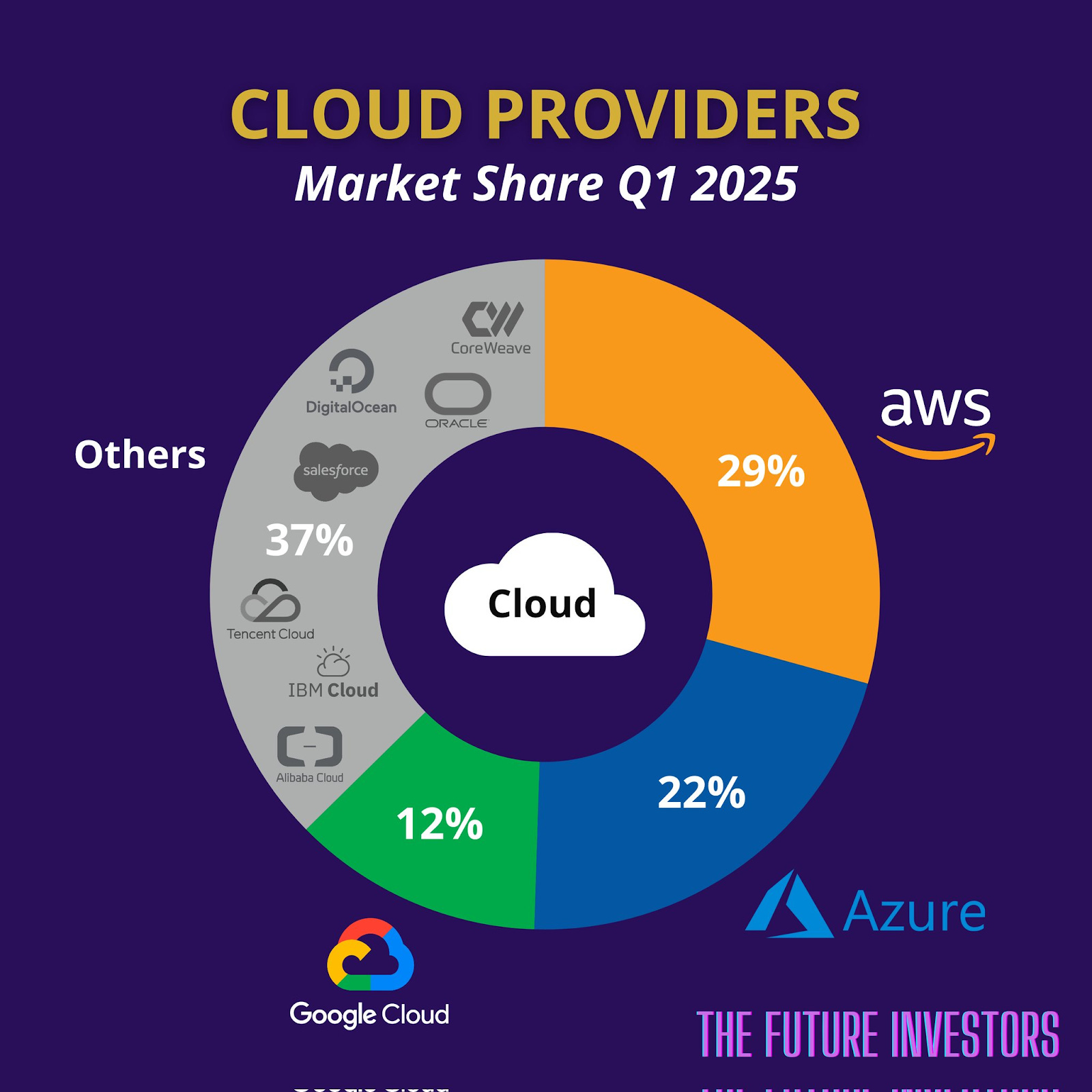
Although AWS remains the dominant player in the cloud market, Azure is not far behind. AWS right now has 29% market share in the cloud space, whereas Azure has 22%, which is impressive.
Microsoft reignited its growth because of Azure under Nadella’s leadership.
Microsoft shared that Azure has surpassed $75 billion in revenue this year. Just to put this in context, Microsoft will do around $300 billion in total revenue this year, which means a quarter of the revenue is directly coming from Azure alone, which is commendable.
But Nadella didn’t just stop with Azure.
Under his leadership, in 2016, Microsoft acquired the networking platform, LinkedIn for $26.2 billion. And two years later in 2018, it acquired the developer platform, GitHub for $7.4 billion. The company also went hard in the gaming industry, acquiring ZeniMax Media for $7.5 billion and Activision Blizzard for $68.7 billion—the last one being the company’s largest acquisition yet. And what’s impressive to me is how all of these acquisitions turned out to be the right decisions for Microsoft.
And now, enter the AI wave.
Microsoft, unlike Apple, isn’t sleeping on AI. The company has made massive deals and partnerships with top AI companies. For example, Microsoft is committed to invest $13 billion in OpenAI, owning a 27% ownership stake, while it also promised to invest $5 billion in Anthropic in partnership with NVIDIA last month.
I have no doubt that the company is right back on track again. Although giving too much credit to the above acquisitions and Azure’s success alone wouldn’t be fair. But guess what? It’s clearly not the case. Under his leadership, Satya Nadella also drastically changed Microsoft’s culture, from Know-it-all to Learn-it-all growth mindset, which gives a huge room for learning, experimenting, and being willing to fail to Microsoft’s employees and teams.
The Winning Formula
So what’s Microsoft’s winning formula?
Let’s be real: For a new company, it takes years to find product-market fit, moat, defensibility, and the right business model. And this is why it’s incredibly hard to really understand a newborn company. But as time passes, things become clear, which I’d say is also quite true for Microsoft.
The older it got, the more we understood the company. And it seems to me that Microsoft now has a clear picture of what market it wants to serve, who its ideal customers are, and its core strengths and weaknesses.
So now it’s somewhat clear, here’s why Microsoft wins:
#1: Sell Utilities, Not Lifestyle
If you’d asked people in the 1980-90s what Microsoft is? They’d tell you that “Well, it’s a consumer company that builds computer-related tech products for everyday people.” Which indeed was true at the time—but certainly not today.
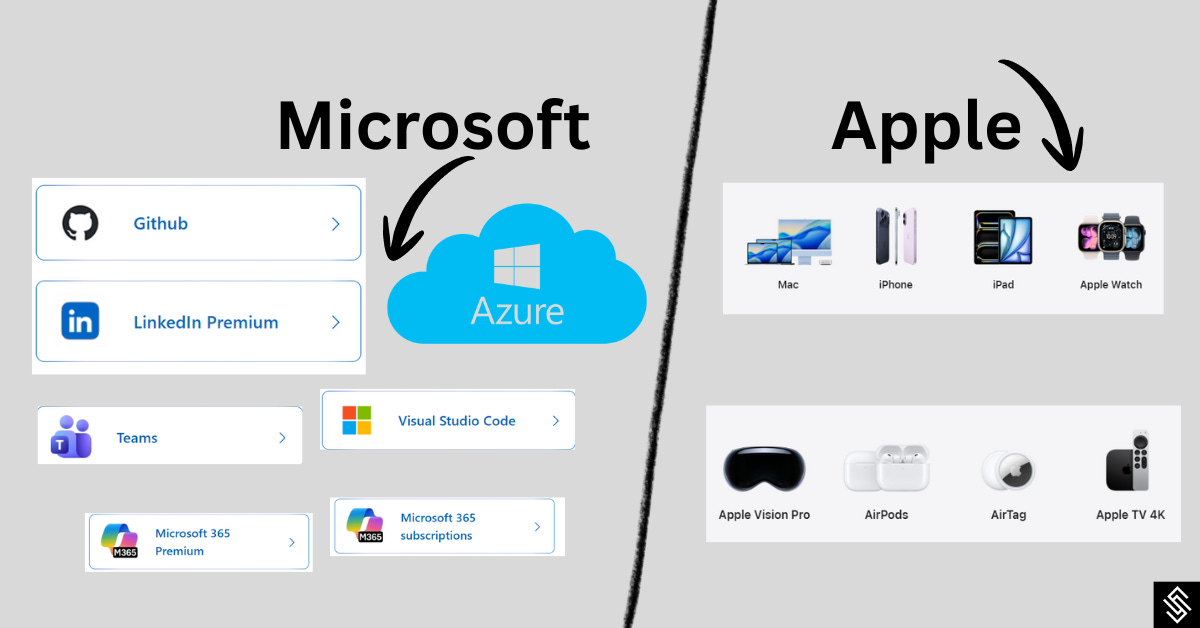
This doesn’t mean Microsoft doesn’t focus on the consumer market. But the reality is, the company is now more focused on serving “Businesses & Enterprises” instead of everyday people. Take GitHub, LinkedIn, Excel, VS Code, and Azure for example, which are primarily built for businesses and enterprises. Of course, I’m not ignoring their consumer products: Xbox, Microsoft Edge, Bing, and Windows.
But their main focus now is business, not individuals.
So when the focus drifts away from the consumer market to business and enterprises, the company doesn’t need to heavy-lift storytelling, marketing, or design. Because the truth is, “Businesses don’t buy from emotion, they buy from logic.” This is the exact reason you don’t often see Microsoft putting too much effort into storytelling, marketing, and design.
A simple comparison that explains it well:
#2: The Ecosystem
To understand Microsoft’s ecosystem well, I’ll simply pick one of its products, LinkedIn.
The company acquired LinkedIn for $26.2 billion in 2016. And now, roughly a decade later, the platform is deeply integrated across Microsoft’s products.
Sounds cliché, but LinkedIn is known for its professionalism, with the most updated data of working professionals available on the platform.
Joining a new company? Update LinkedIn
Resigning from a company? Update LinkedIn
Starting a new company or firm? Update LinkedIn
People on LinkedIn literally do this. And this gives a huge data advantage to Microsoft, deeply integrating it with its Microsoft 365, Outlook, Teams, and Copilot. And then there’s the LinkedIn feed that provides a real-time labor market: skill demand, hiring trends, and job mobility, and which can be advanced-searched, filtered, and accessed via Microsoft products.
This is Microsoft’s ecosystem 101.
But it’s not just LinkedIn. Almost every product Microsoft has ever built or owns tends to be tightly integrated across all its products. For example, when you create a document on Word or Excel, it gets automatically saved to OneDrive, which allows real-time collaboration with teams and colleagues.
Overall, this gives Microsoft three big advantages:
Makes the switching costs high
Gives customers a smooth working experience
Creates strong network effects so products become valuable over time
And this right there is powerful.
#3: Massive Distribution
As Reid Hoffman puts this in his book Blitzscaling:
“Many people in Silicon Valley like to focus on building products that are, in the famous words of the late Steve Jobs, “insanely great.” Great products are certainly positive, but the cold and unromantic fact is that a good product with great distribution will almost always beat a great product with poor distribution.”
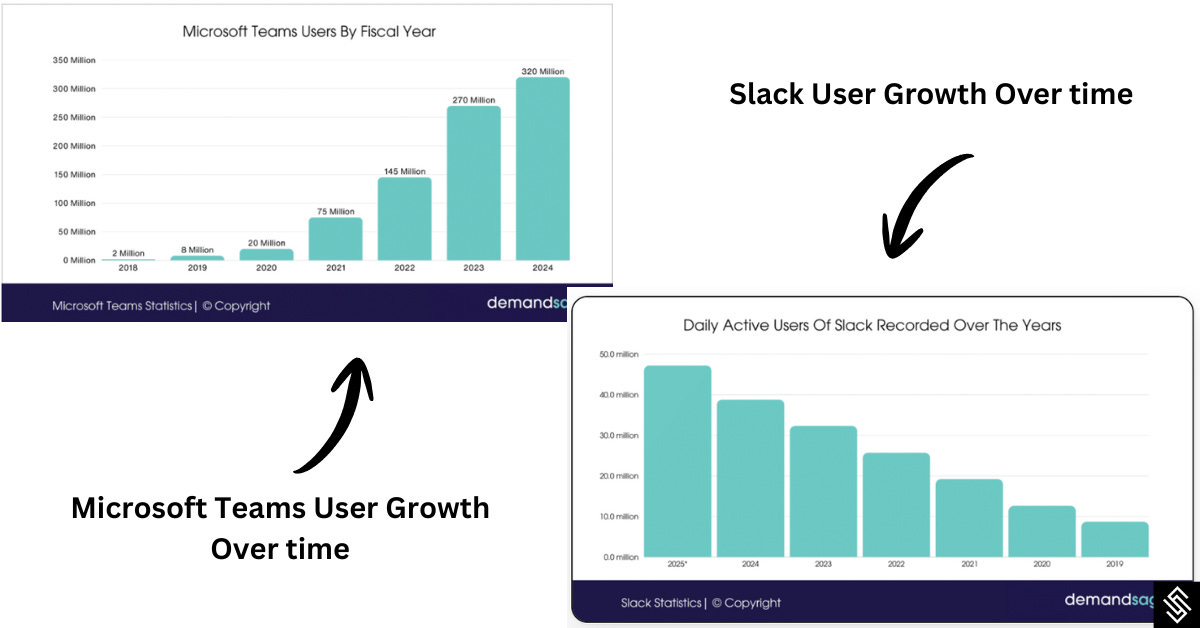
Why is it that Microsoft Teams has over 320 million monthly active users, whereas Slack, around 80 million monthly active users? The answer is simple: It’s nothing but the power of great distribution. The sole reason Microsoft Teams has 4 times the Slack users is that Microsoft has a massive distribution reach, bundling and deeply integrating Teams into its 365 Office Suite and across the platform—in Microsoft’s deep ecosystem.
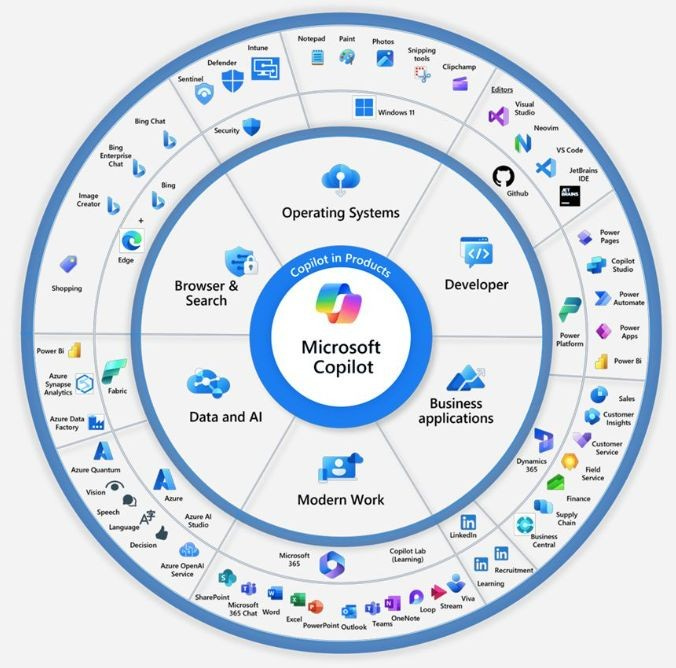
Microsoft’s huge distribution power doesn’t just allow its existing products to succeed, but it also gets a lot easier for the company to make a new product successful, for example their new AI assistance, Copilot. No one would be paying attention to Copilot if it were a standalone product with no distribution added. But because of Microsoft’s powerful distribution, it is tightly integrated across its products, so its customers can use it without the company doing heavy marketing.
The 100,000 Foot View
The conventional wisdom for building a successful company goes like this: build great products, do excellent marketing, nail storytelling, focus on branding, and be exceptionally great at design. But as you see, this post proved that that’s not always the case—certainly not for Microsoft.
Microsoft builds useful products, not great or life-changing products, aiming to be just “Good enough.” And since the company has shifted its focus to serving businesses and enterprises, it doesn’t obsess over storytelling, marketing, and design—never has.
Another thing worth pointing out about Microsoft is that the company has barely invented any product it sells—original thinking isn’t something Microsoft is good at. But guess what? It’s not really a problem for the company, and it shouldn’t be for you either. It’s absolutely fine to steal what already works. And as long as Microsoft provides value, solves real-painful-boring problems, and prints money doing that, the company is fine.
However, there’s one important thing to note here.
To accomplish what Microsoft has accomplished, companies must know their strengths and weaknesses. Microsoft leaned into what it was good at, doubling down on that. And it worked quite well for them. But if you blindly apply what worked for Microsoft, it may be a disaster for your company. You must first understand the rules so you can break them later.
Thank you for this long read. Microsoft is the main position in our fund with a 12,5% allocation.
Explanation was top notch, I am one of those guys who isn't a big fan of Microsoft - but, despite it's haters, it's still out there...and why is that? I learned that today.
Good post!