
Builder AI: What Went Wrong?
The Collapse of $1.5 Billion (AI?) Company

In 2023, Fast Company nominated Builder AI the 3rd most innovative company in AI, right behind OpenAI and Google’s DeepMind, while NVIDIA, the largest company in the world right now with over $4.5 trillion in market cap, was in the sixth position.
But this year in May, Builder AI went bankrupt, and the company is no longer operational. How a company that was the third most innovative company in AI with over $1.5 billion in valuation just two years ago, collapsed all of a sudden?
It turns out, Builder AI was not even an AI company, which it claimed to be. The company’s valuation grew mostly through hypes and fake promises that they weren’t even delivering to their customers in the first place. On top of that, the pandemic became a big factor for the company’s growth, which I’ll go through in the piece.
I think the collapse of Builder AI is one of those stories that especially alarms investors to make sure that they understand the company properly and know the details before they invest in that company. As the saying goes, “Believe none of what you hear and half of what you see,” which perfectly fits with this story.
Here’s the full story of how Builder AI collapsed:
The Back Story
The so-called London-based “AI startup,” Builder AI was founded in 2016 by Sachin Dev Duggal, promising to revolutionize the software development process for (small) companies. Precisely, the idea was to build software and apps for non-tech companies as easily as ordering a pizza, faster and cheaper.
The company officially launched the platform in 2018, first naming it Engineer.AI, and raised its first venture fund, Series A of $29.5 million from Lakestar and Jungle Ventures. The next year in 2019, the company rebranded its name to Builder AI, with its AI being Natasha.
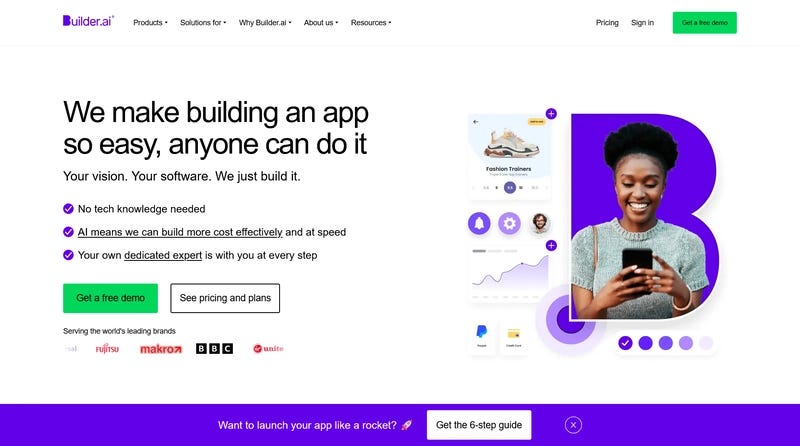
It sounded promising until it wasn’t. They marketed the product as an “AI-powered” platform that helps develop software, tools, and apps for their clients, with 80% of the development being done by their so-called AI model, Natasha. But it turns out that there was no AI developing the products, instead it was 700 Indian programmers vibe-coding for their clients’ required products.
For example, you wanted Builder AI to help you build an app. All you had to do was select the product you want to build, the features you want to have, the pages, the integrations, etc. Once you submit the “Request,” their AI would make a quick prototype (which they had already pre-built for multiple uses!), and it’d say that the final product will take a few weeks to months, depending on the requirements.
Even though the company was never true to its work, it had raised a whopping $450 million from Microsoft, Softbank’s DeepCore, the Qatar Investment Authority, Jungle Ventures, Lakestar, Insight Partners, and more. And the company had around 1,500 employees working from multiple countries (majority India), and was valued at $1.5 billion in 2025 before it collapsed.
So what went wrong? Let’s unpack!
What Went Wrong
There wasn’t just one thing that was wrong about the company, actually the whole company was “Smoke and mirrors,” hiding truth behind the curtain, faking about their vision, the way they operated, and the financials. It was all lies, head to toe.
I’ll go through as many as I can.
1. The Work
What they called their AI, Natasha, didn’t even exist. Instead the products and tools the company’s clients asked to build were manually coded by 700 Indian programmers. Although the AI part did help with frontier transactions like showing the progress bar or accepting the product requirements, so it makes the clients feel like the work is actually being done by an AI.
Going deeper, what they actually had in their systems was two pieces of tech: First, pre-coded blocks of reusable features such as user logins, payment integration, contact page etc., which they’d often need for every client. And then there was a second piece of tech, which was proprietary AI tools that those 700 programmers would actually build in real time.
But what’s more interesting is that even though they had pre-coded features, in the first prototype sent to clients often tended to lag and didn’t work properly, which was frustrating for the customers. And this leads us to the second problem.
2. The Clients
The Builder AI customers weren’t happy.
The company would give an estimated timeline to complete a project, but they’d often miss the deadlines and postpone it, promising to deliver the next time. Because of this, many clients would cancel the project in the middle, and many would also refuse to pay the unpaid amount (you could pay in installments).
3. The Financials
This is where the reality came out.
The pandemic massively helped the company grow. They had raised multi-million dollars in funding, but since the pandemic had hit, “no one could go to the Builder AI office, pull out the data, and match the actual number of what they were claiming,” said one of its investors.
In a few years, from 2020 to 2023, Builder AI’s growth skyrocketed. From the outside, it looked impressive: $450 million in funding, over $100 million in annualized revenue, tens of thousands of customers. On top of that, they were gaining popularity and media coverage consistently, making it unreasonable to question the finances.
But around late-2024, the board looked suspicious: How could the company have little cash despite its fast growth and revenue? They questioned, eventually finding out that the numbers were drastically overstated. The company’s revenue for the 2023 fiscal year was reported $157 million, while the actual revenue was $42 million. In 2024, the company reported a total of $217 million in revenue, while the actual revenue was $51 million.
Not only that, the company owed $75 million to AWS, vendors were unpaid, and employees’ salaries were delayed multiple times. This was truly shocking. And the funniest part? Despite being a unicorn, the company didn’t even have a CFO until 2023 lol.
The board made a quick decision to fire its CEO, Sachin Dev Duggal (calls himself Chief Wizard), and assigned one of its investors, Manpreet Ratia, as the new CEO, hoping to save the company.
But it was already too late.
A few weeks after the leadership change, the Israeli lending firm Viola Credit, which had given money to the company, analyzed the company’s financials, as they were also skeptical about the stated numbers. And they learned (the board didn’t want Voila Credit to know it!) that it’s all overstated numbers on the spreadsheet. Viola Credit immediately froze Builders’ AI accounts and seized remaining cash, confirming that financial discrepancies were real and severe, leaving the company with no other option than to file for Chapter 7 bankruptcy this year in May 2025.
4. The Marketing
You may ask: The company had raised $450 million, so where did all the money go? In just one word: Marketing. They spent roughly 80% of their revenue and funding on marketing the product, instead of making it better, improving it, or scaling it, etc.
The company poured millions into advertising its AI, Natasha. Just a few examples: They were at the Web Summit Conference in Lisbon, were Gold Partners at TechCrunch Disrupt Conference in SF, and were advertised at Gitex Global Conference in Dubai. They were spending literally tens of millions of dollars advertising the product all over the world.
Then comes their online marketing. One of Builders AI's YouTube videos has over 6.9 million views…what do you think they got it organically? Nope, they poured money into buying these views. I know what you’re saying: “How’s all this even possible?” Then she whispered, “It’s basically magic.”
More Magic
You may think, “Well, it’s just one company, why should we care?” I wish I could say it was true, but the reality is, it’s definitely not. Builder AI's story isn’t the only one, the list is too long. In recent years, we have seen a ton of cases, companies selling misleading products, committing fraud, scamming their clients, or even money laundering.
For example look at these three:
#1: Humane AI Pin: Founded in 2017 by former Apple executives Imran Chaudhari and Bethany Bongiorno, Humane promised to revolutionize the smartphone industry by replacing it with a screen-less, AI-driven device that will completely replace the smartphone. They had secured $240 million from Sam Altman, Microsoft, Marc Benioff, and others. But when the actual product came out in the market around 2024, it was a disaster. MKBHD made a video saying, “The Worst Product I’ve Ever Reviewed.” In February 2025, Humane AI sold all its assets to HP for $116 million and shut down the company.
#2: Nate: A New York-based AI startup, Nate, promised to streamline the shopping experience by skipping the checkout process for the consumer when buying products online on e-commerce sites. Investors poured $40 million. But in 2022, the Information wrote that Nate wasn’t an AI, instead the company had contractors in the Philippines who were manually completing each sale. The company eventually shut down the operation.
#3: GameOn: Another SF-based AI startup, GameOn, founded by Alexander Beckman and her wife, Valerie Lau Beckman, who ran an AI sports chat, was charged with fraud allegations and scamming people in January 2025. They did all the fake things: Fake reviews, fake bank statements, stolen identities, and diversified millions of GameOn dollars to pay for personal expenses, including the couple’s wedding and their house. Investors lost somewhere between $60 to $80 million in GameOn.
So, are we in an AI Bubble?
Straight to be clear: There’s no correlation between the AI bubble and Builder AI. We could argue, “Yeah, it’s all an AI bubble,” only if the company was built off of AI: model training, compute, spent billions of GPUs and chips.
But Builder AI never did any of that.
Now, to think about whether we are an AI bubble or not, I think there’s a useful perspective I have that’d make a ton of sense. What’s that? Remember the 2002 Dotcom Bubble? The reason the Dotcom Bubble occurred was that the internet companies’ valuations were off the charts. The valuations were too high, while they had no business model, moat, product-market-fit, or usefulness.
The market realized that, and crashed. But did it kill all tech companies? No. Amazon, Apple, Microsoft, Google, NVIDIA, and many valuable companies survived and later shaped the world. The Dotcom Bubble only killed bad companies and made a correction in the market, which needed to happen to know the actual worth of those tech companies.
I think it’s the same case with AI. Artificial Intelligence is a technology that allows companies like OpenAI, Anthropic, Cursor, Runway, etc. to build AI products. But it’s obvious that most AI companies don’t even have a working product, product market-fit, moat, business model, or usefulness, while their valuations reaching sky-high.
Trillions of dollars are being spent on AI infrastructure, data centers, model training, etc. Of course, these expenditures are required to get the technology off the ground and to fulfill the demand. But what’s worth pointing out is that the market is too hyped on AI that it’s pouring money everywhere there’s AI, which created new markets we didn’t need, products we didn’t need, and the companies’ valuation is off the chart while they aren’t anywhere near being profitable any time soon.
And that’s the issue.
And this means we may see a correction in the market. A bubble will pop and kill “only” those companies that are bad: have no actual product, no business model, over-valued, zero moat, etc. Those types of companies will collapse. But the companies that have real products, creating demand, and finding success, won’t go anywhere. Of course, when the bubble pops, these companies will also see a correction. But once the bubble is over, they will grow just like Amazon, Apple, Google, and Microsoft did in the late 2000s.
And then maybe, just maybe we’ll have AGI.
Excellent analysis! The 'not even an AI company' point is crucial.
Builder AI’s collapse underscores the risk of hype-driven valuations. AI branding alone isn’t enough without product-market fit, real tech, and financial transparency.